There’s a strange honesty in the space between stimulus and response.
If you’ve ever trained a dog—or tried to—you know that gap all too well.
A moment where your dog does something right or wrong, and you… hesitate. Or react too fast. Or not at all. Maybe you’re still processing what happened or unsure of the “right” thing to do. Either way, that moment matters more than you think.
The first time I heard about the 5-second rule in dog training, I thought it was about efficiency. Like a productivity hack, but for obedience. Correct your dog within five seconds or else. That kind of thing. But that’s not what it is—not really.
It’s more about timing and clarity than control. It’s a rule that applies to nearly every interaction with your dog. Whether training, introductions, petting, or setting boundaries, those few seconds shape how your dog understands the world.
Curious what this looks like in action? Let’s get into the “why” behind it—and how to apply it with your dog in real life.
The 5 Second Rule says: You have roughly five seconds to respond to your dog’s behavior for your feedback to make sense to them.
It’s not arbitrary—it’s biology. Dogs live in the now. Not the “two minutes ago when he chewed your shoe” moment. Not the “ten seconds from now when you’re finally calm enough to say something nice” moment.
They’re anchored in the present. And if your feedback doesn’t land right there, in that window, the message gets fuzzy.
Praise, correction, redirection, even a simple “yes” or “no”—it all needs to happen within that short window if you want your dog to associate your reaction with their action.
We humans don’t operate like that. We overthink, delay, and moralize. We make everything personal.
When a dog misbehaves, we often wait—partly because we’re unsure what to do, partly because we’re hoping it’ll stop on its own, and sometimes because we don’t want to “ruin the vibe.” But in that silence…your dog has already moved on.
And no, five seconds isn’t some magical number written in stone. Some dogs connect the dots faster; some need a little more consistency. But five seconds is a useful guideline—long enough to react, short enough to still be relevant.
Well…the stakes are higher:
When you’re working with a dog trained to bite on command, to stand their ground in high-stakes scenarios, or to disengage instantly on cue, that 5-second window becomes a razor-thin line between clarity and confusion or safety and chaos.
Protection work is built on precision—split-second decisions and laser-focused responses. And if your dog doesn’t get clear, timely feedback from you, they start to fill in the blanks or, worse, second-guess your commands.
In the real world, that’s a security risk.
The 5 Second Rule matters here because it reinforces what every protection dog needs most: clarity of communication. Your timing tells the dog exactly what you expect—and when.
If your dog makes a mistake—acts without permission, engages when they shouldn’t—and your reaction comes too late, you’re not just correcting the wrong behavior… You’re punishing the wrong mindset.
Let’s say your protection dog steps forward during a routine conversation with a stranger, and you hesitate. A minute passes. The dog settles back to heel and relaxes. Then you tighten the leash or raise your voice.
What behavior did you just correct?
Not the forward motion. Not the mistake. You just punished the return to heel. The calm. That’s where confusion starts and frustration follows.
When a protection dog can’t clearly associate your correction with their action, they start guessing. Is it wrong to move or stay? What will be the consequence of my actions?
And in protection work, that kind of uncertainty is dangerous. It doesn’t make your dog more obedient—it makes them more anxious, more reactive, and harder to read.
Punishment—especially when it’s late—erodes communication and weakens trust.
Meeting new people, pets, entering unfamiliar environments, and interacting with kids, delivery drivers, and friends—it all matters, and the first 5 seconds say a lot.
Dogs rely heavily on body language, scent, and tone—things we often overlook—to interpret their environment and interactions. The first few seconds of a meeting shape their initial impression of the person or place.
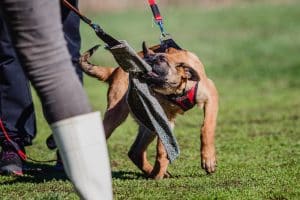 If you’re tense, pulling back, or overly forceful, your dog picks that up. If you’re calm, open, and confident, they register that too.
And in protection dogs—these aren’t just social cues. These are safety assessments.
That’s why your behavior in those opening moments sets the tone. Are you relaxed but alert? Are you standing tall and in control? Are you giving the dog permission to observe before engaging?
So, if you hesitate or send mixed signals, your dog might act on instinct. Posture up, growl, or block the person.
But when you lead with clarity and control—steady voice, grounded energy, deliberate body language—your dog sees that and mirrors it. They learn: “My handler’s got this. I don’t need to jump in.”
Of course, that trust doesn’t build in one meeting. It’s gradual. And those first five seconds? They’re your foundation.
Don’t be the guy who can’t take a hint.
We all know him. The person who won’t stop petting the dog—even when the dog is clearly over it. Tail stiff, ears back, eyes flicking to the exit. And yet… the hand keeps going.
Part of building a healthy bond with your protection dog is knowing when to back off. Petting isn’t just about love—it’s about consent, respect and mutual trust.
And yes, the 5-second rule applies here too.
Here’s how it works:
The 5 Second Rule may be the backbone of timing, but it’s not the only rule that matters in protection dog training.
So, for your dog to listen under pressure, trust your direction, and perform consistently, you must build your training around principles that hold up when things get real.
Here are five foundational rules that every handler should know, live by, and never skip:
It happens. Someone calls their dog’s name once, twice, five times—each time louder, each time more frustrated—while the dog continues sniffing a tree, watching a squirrel, or just… ignoring them.
Repeating cues over and over teaches your dog to ignore you. It turns your voice into background noise. Instead of associating “Come” with a clear, direct action, they think, “I’ll wait until the fourth time—they’re not serious yet.”
In protection work, that delay can’t happen.
Say it once. Pair it with one clear consequence or reinforcement. And if they miss the mark? That’s not failure—it’s a training opportunity. Clarity, consistency, and timing always win.
Rewarding the behaviors you want to see again teaches protection dogs to act confidently and precisely.
Now, I know what you’re thinking: Do I have to bribe my dog just to get him to listen? Not at all. You’re building meaningful feedback loops: You did the right thing—here’s your reward.
It could be praise, play, food, a marker word, or a moment of affection. What matters is that it’s clear, timely, and consistent.
And the science backs this up—again and again.
In 2008, Dr. Emily Blackwell and Caroline Twells found that dogs trained with positive reinforcement were less likely to show fear or aggression than those trained with punishment.
The following year, Dr. Meghan Herron and Frances Shofer showed that even what many consider “mild” punishments were linked to higher levels of fear and aggression.
Then in 2010, another study reinforced the same pattern: more punishment correlated with more reactivity.
Dogs learn faster, stay more motivated, and build deeper trust when training feels safe and rewarding—not uncertain or fear-based.
And let’s be honest—you want a protection dog that performs because they understand you, not because they’re scared to mess up.
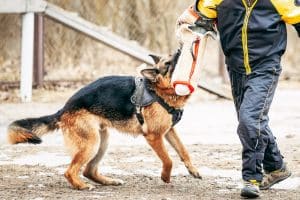 You’re training a protection dog—not checking boxes. That means you can’t afford to skip any stage of development, no matter how tempting it is to fast-forward. Rushing the process rarely gets you results—it usually gets you setbacks.
When you push too fast, you risk confusing your dog, undermining their confidence, or worse—triggering behaviors you don’t want.
Protection work is serious business. You’re not just teaching obedience. You’re shaping judgment under pressure. So, every session, every repetition, every moment of clarity compounds over time.
Dogs don’t do grey areas. One day it’s okay to jump on the couch, the next it’s not? That’s not training. That’s confusion.
Your dog needs you to be predictable. Clear rules, enforced the same way every time, give them structure and safety. Whether you’re at home or in public, clarity builds confidence—and that confidence keeps reactivity in check.
It’s one thing to have a flawless heel in your backyard. It’s another to hold that focus in a parking lot, at the vet, or during an unexpected interaction.
Protection dogs need to generalize their training across environments. Practice in low-distraction areas, then layer in noise, motion, people, and unpredictability.
Most people overcomplicate this. They focus on advanced techniques while neglecting the fundamentals. But the math is simple:
Clear rules + Perfect timing + Consistent application = Predictable results
However, when the stakes include your family’s safety—this isn’t the place for trial and error or YouTube shorts.
That’s why professional guidance is crucial
A well-trained protection dog represents an investment that grows in value daily. Not just in financial terms, but in the currency that matters most: security and peace of mind.
But results like that only come from experts who’ve done this hundreds of times—successfully.
Vanguard Protection Dogs exists for one reason: to build elite, reliable, and battle-tested dogs.
Contact us today. Or schedule a consultation and find out what certainty feels like.
 904-441-8475