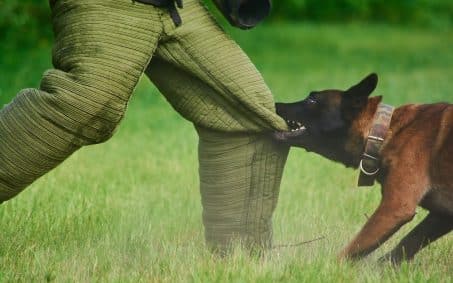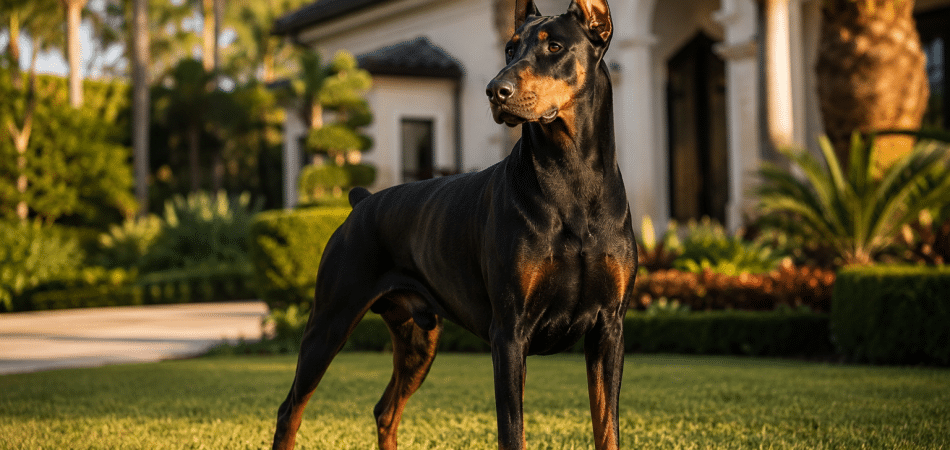
Doberman Pinschers rank among the top protection dog breeds due to their intelligence, speed, loyalty, and trainability. Originally developed in Germany specifically for personal protection work, the breed combines an imposing physical presence with a deeply affectionate temperament around family members.
Their short coat adapts well to warm climates like Jacksonville, Florida, and their athletic build allows them to cover ground quickly across suburban and estate properties. Professional protection training channels their natural guarding instincts into controlled, reliable responses that keep families safe without unprovoked aggression.
Jacksonville families looking for a protection dog that combines athletic power with unwavering loyalty are increasingly turning to the Doberman Pinscher. Once stereotyped as aggressive or unapproachable, the modern Doberman has earned a reputation as one of the most intelligent, family-friendly, and trainable protection breeds in the world. For households across Northeast Florida seeking a dog that can protect the property, bond with children, and move confidently through social settings, the Doberman checks every box.
Vanguard Protection Dogs brings 16+ years of selective breeding and advanced training experience to every placement. With AKC-registered, FCI-certified, and OFA-certified dogs sourced from elite European bloodlines, Vanguard Protection Dogs places just 12 to 15 fully trained protection dogs per year. That exclusivity, paired with a 5.0-star client rating and trainer certifications recognized by elite European police agencies, reflects a standard built for high-net-worth families with serious security needs.
Families considering a Doberman Pinscher for protection can start with a free initial consultation to discuss their security concerns, property layout, and lifestyle requirements.
Doberman Pinschers were originally developed in late 19th-century Germany by tax collector Louis Dobermann specifically for personal protection. The breed combines speed reaching up to 32 miles per hour, a lean muscular frame of 60 to 100 pounds, and a lifespan of 10 to 13 years with an intelligence ranking among the top five of all dog breeds, making them one of the most purpose-built protection dogs in existence.
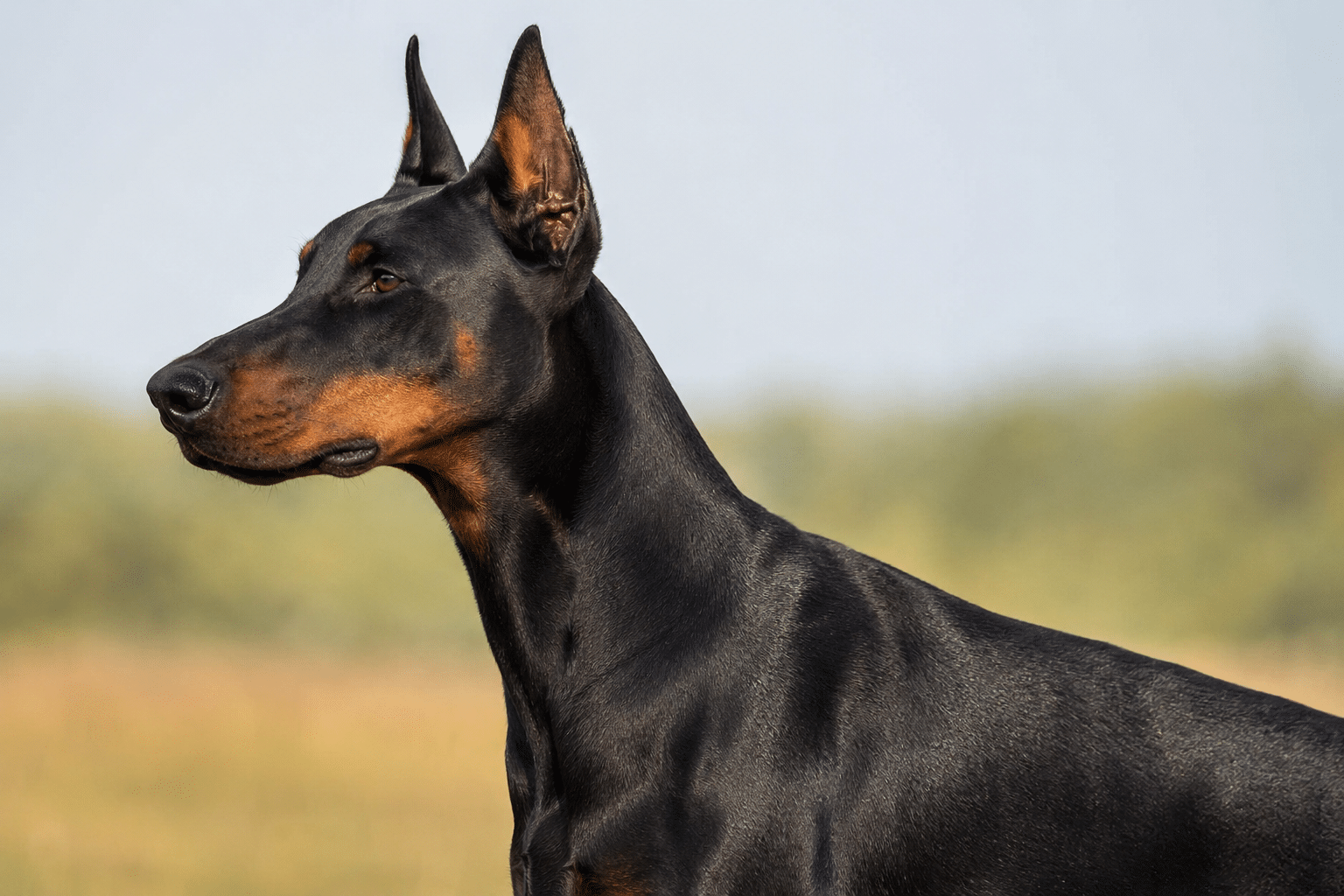 Unlike many breeds that were adapted from herding, hunting, or working stock into protection roles, the Doberman Pinscher was created with one goal in mind.
Louis Dobermann, a German tax collector who also ran the local dog pound in the 1880s, needed a medium-large companion that could accompany him on dangerous collection routes.
He selectively crossed several breeds to produce a dog with the perfect blend of alertness, courage, loyalty, and physical capability.
That origin story matters because it means protection instincts are hardwired into the Doberman’s genetic makeup. These dogs do not need to be taught suspicion or territorial awareness from scratch. Professional training builds on instincts already present, refining them into controlled, reliable responses.
The Doberman Pinscher consistently ranks in the top five most intelligent dog breeds according to canine behaviorists. That intelligence translates directly into faster acquisition of obedience commands, protection protocols, and situational judgment. Dobermans can read human body language with remarkable accuracy, a trait that allows them to assess whether a stranger represents a genuine threat or a friendly visitor.
This perceptiveness sets the Doberman apart from breeds that rely more heavily on handler commands to determine threat levels. A well-trained Doberman processes environmental cues independently while still responding instantly to verbal or physical commands from its handler.
Doberman Pinschers stand 24 to 28 inches at the shoulder and weigh between 60 and 100 pounds, with males generally larger than females. Their lean, muscular build allows them to accelerate quickly and sustain pursuit over short distances. Unlike heavier breeds such as Rottweilers or Bullmastiffs, Dobermans combine power with agility, making them effective in both open-property patrol and confined indoor settings.
The breed’s endurance supports sustained alertness over long periods, an attribute that matters for families who need a dog capable of maintaining protective awareness day and night.
Doberman Pinschers offer distinct advantages over other popular protection breeds in several categories, including speed, heat tolerance, handler-bonding intensity, and visual deterrence. Each breed brings different strengths to protection work, and the right choice depends on the owner’s family composition, property size, climate, and specific security concerns. Understanding those differences helps families select the breed that fits their situation.
German Shepherds remain the most widely placed protection breed worldwide, with a lifespan of 9 to 13 years and a heavier build of 50 to 90 pounds. They offer superior tracking and scent work capability and adapt well to multi-handler environments. Dobermans, by contrast, are faster, more agile, and tend to form a more intense bond with a single primary handler.
In warm climates like Jacksonville, the Doberman’s short single-layer coat provides a practical advantage over the German Shepherd’s thick double coat, which requires more heat management during Florida summers. Families can explore how a distinctive approach to breeding and training matches the right breed to each household’s specific needs.
Belgian Malinois bring unmatched energy and drive, with a lifespan of 12 to 14 years and a lighter frame of 40 to 80 pounds. They excel in high-intensity operational environments and are the preferred breed for many law enforcement and military applications. However, that extreme drive can overwhelm households that lack experience with working-line dogs.
Dobermans offer a more balanced energy level for residential settings. They remain alert and engaged without the near-constant physical and mental stimulation demands that Belgian Malinois require. For families with children or households where the dog will spend significant time indoors, the Doberman often presents a more manageable daily routine.
Rottweilers weigh 80 to 135 pounds and provide a powerful physical deterrent through sheer size and strength. Their lifespan of 8 to 10 years is shorter than the Doberman’s 10 to 13 years. Rottweilers excel at stationary guarding and property deterrence but are slower and less agile than Dobermans in pursuit or rapid-response scenarios.
Dobermans compensate for their lighter frame with speed and versatility. They transition smoothly between indoor family life and outdoor property patrol, adapting their energy level to the situation. That versatility makes them particularly effective for families who need a single dog that fills both companion and security roles.
Protection dog training follows a structured progression from foundational awareness through elite operational capability. Doberman Pinschers respond exceptionally well to this progression because of their intelligence, drive, and willingness to work closely with a handler. Understanding the three primary training levels and the certifications that validate them helps families select a Doberman trained to the right standard for their security needs.
Level 1 training establishes the baseline of protection capability. Dogs at this level demonstrate bark-on-command, territorial awareness, boundary respect, controlled aggression, and the ability to provide protection when necessary. For families in Jacksonville neighborhoods and gated communities, a Level 1 Doberman adds a living deterrent layer that passive security systems cannot replicate.
Dobermans at Level 1 are fully socialized for daily family life. They walk calmly on leash, interact safely with children and guests, and transition smoothly between relaxed home behavior and heightened alertness when a potential threat is detected.
Level 2 training adds active defense, premise searching, object guarding, perimeter defense, and situational response under pressure. Dobermans trained to this level actively patrol designated areas and respond to threats with controlled force rather than simple alerting. For estate owners and executives in Northeast Florida, Level 2 training provides the active defense capability that families with elevated security concerns require.
Elite-level Dobermans work alongside professional security teams, respond to off-leash commands, interpret silent cues and body language changes, and operate effectively in complex environments. Working with protection dog experts in Jacksonville helps match the right training level to each family’s specific security profile.
The IGP (Internationale Gebrauchshund Pruefung), formerly known as IPO or Schutzhund, is the international gold standard for protection dog certification. It evaluates tracking, obedience, and protection skills across three progressive levels. A Doberman holding IGP certification has demonstrated reliable performance under standardized testing conditions recognized worldwide.
The BH (Begleithund) companion dog test serves as a prerequisite for IGP and confirms basic obedience and social stability. AKC CGC (Canine Good Citizen) certification verifies the dog’s behavior in public settings. OFA (Orthopedic Foundation of America) clearances for hips, elbows, and cardiac health confirm the dog’s physical soundness for demanding protection work over its full lifespan.
Jacksonville’s climate, property mix, and regulatory environment create conditions that favor Doberman Pinscher ownership for protection purposes. The city’s warm, humid weather suits the breed’s short coat, its range of suburban estates and waterfront properties provides ample space for exercise, and Florida’s absence of state-level breed-specific legislation removes a legal barrier that restricts Doberman ownership in other parts of the country.
Doberman Pinschers carry a short, single-layer coat that handles heat and humidity more efficiently than the double coats found on German Shepherds, Belgian Malinois, and Dutch Shepherds. In Jacksonville, where summer temperatures regularly exceed 90 degrees Fahrenheit with high humidity, that coat difference translates into less heat stress, fewer grooming demands, and a more comfortable dog during outdoor activity.
Owners in Northeast Florida still need to provide shaded rest areas, consistent hydration access, and adjusted exercise schedules during peak afternoon heat. But overall, the Doberman requires less climate management than thicker-coated protection breeds in the same environment.
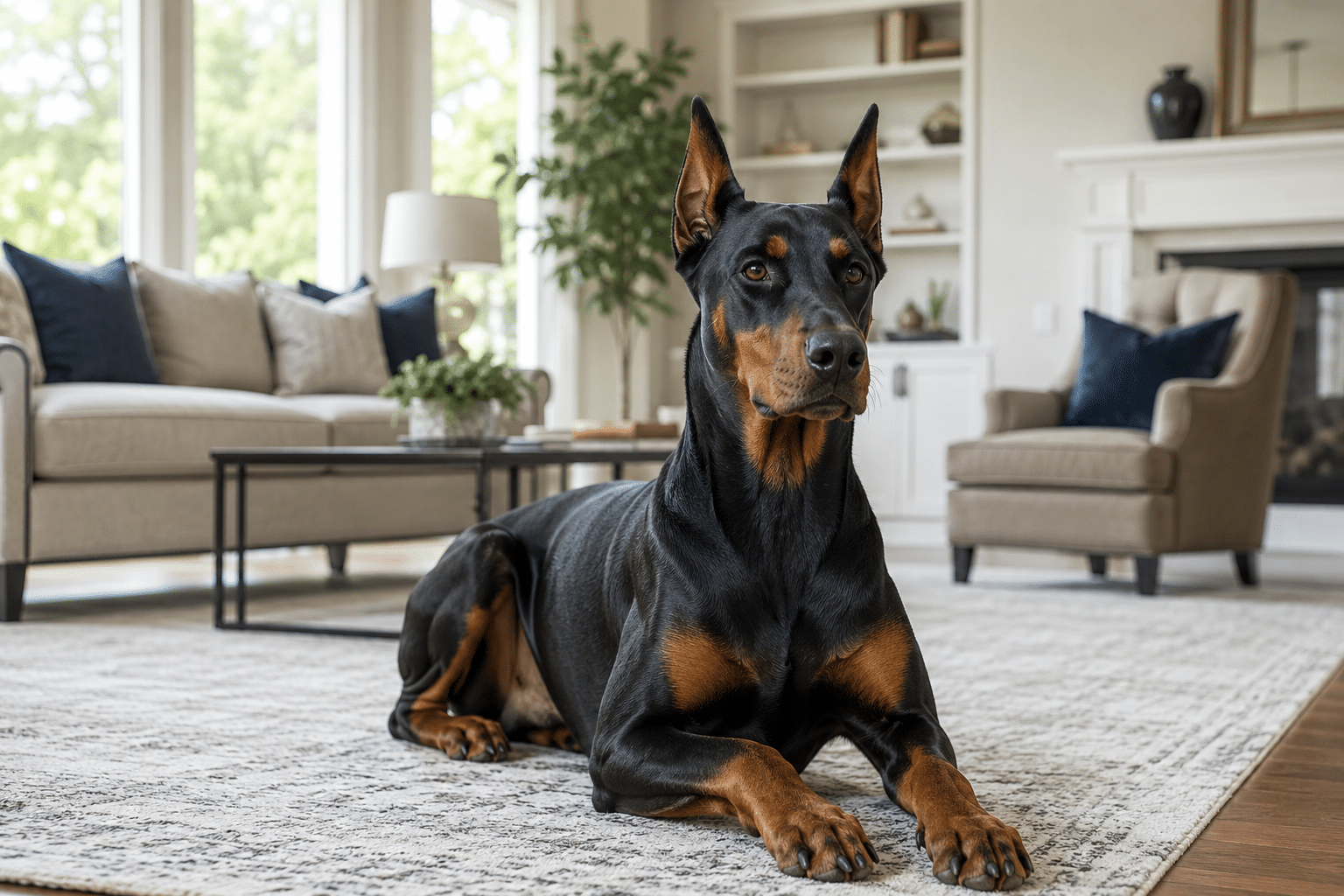 Jacksonville’s residential market includes everything from Ponte Vedra Beach estates to suburban family homes in Mandarin, San Marco townhomes, and rural acreage in western Duval County.
Dobermans adapt effectively across all of these settings. Their moderate size allows comfortable indoor living in smaller homes, while their speed and endurance make them capable patrollers on larger properties.
During hurricane season (June through November), a Doberman provides security continuity when power outages disable alarm systems and camera networks.
The dog operates independently of grid power and maintains its protective function regardless of weather conditions. Families considering how different protection breeds compare in these scenarios can review a detailed Belgian Malinois vs German Shepherd breakdown to see where the Doberman fits into the broader breed selection picture.
Florida has no breed-specific legislation at the state level, meaning Doberman Pinscher ownership is not restricted by the type of blanket breed bans that exist in some municipalities across other states. Individual Florida municipalities may have local ordinances, so families should verify their specific city or county regulations before placement.
Homeowner insurance policies vary in how they classify protection dogs. Some insurers list Dobermans among breeds that may affect coverage terms or premiums. Consulting with an insurance provider before placement allows families to adjust policies proactively and avoid coverage gaps.
Vanguard Protection Dogs has spent 16+ years building a protection dog program designed for families who demand the highest level of security and companionship. Every Doberman Pinscher placed by the team is AKC registered, FCI certified, and OFA certified, with European bloodlines selected for intelligence, temperament, and physical capability.
The Vanguard team’s 5-Pillar System covers every stage of the process. Nature handles pedigree and genetics selection. Training applies the latest scientific research and proven techniques. Matching pairs the right dog with each client’s lifestyle and family composition. Concierge Onboarding delivers the dog door-to-door with an immersive 3-day training experience. Aftercare provides lifetime support with guaranteed response within 24 hours.
With only 12 to 15 placements per year, each Doberman receives individual attention matched to the owner’s property, family dynamics, and security requirements. That level of personalization is what separates Vanguard Protection Dogs from volume-based operations.
Jacksonville families ready to explore whether a Doberman Pinscher is the right protection dog for their household can call (904) 822-1609 or schedule a consultation to discuss breed selection, training levels, and the placement process.
Vanguard Protection Dogs is based in Jacksonville, Florida, and delivers fully trained protection dogs nationwide with a concierge onboarding experience.
Doberman Pinschers are among the best family protection dogs when professionally trained and socialized. They bond deeply with household members, are naturally gentle with children they know, and possess the alertness and physical capability to deter threats. Proper training channels their protective instincts into controlled, reliable behavior rather than reactive aggression.
Doberman Pinschers have an average lifespan of 10 to 13 years. Dogs from OFA-certified breeding programs with documented hip, elbow, and cardiac clearances tend to fall on the higher end of that range. Regular veterinary care, proper nutrition, and consistent exercise contribute to a longer, healthier life for the breed.
A properly trained Doberman Pinscher is not aggressive toward strangers. Protection-trained Dobermans learn to distinguish between normal social interactions and genuine threats. They remain calm and composed around guests, delivery personnel, and neighbors while maintaining the readiness to respond if a real threat presents itself.
Doberman Pinschers adapt well to warm climates like Jacksonville, FL. Their short, single-layer coat handles heat more efficiently than double-coated breeds like German Shepherds. Owners should provide shade, fresh water, and adjusted exercise schedules during peak summer months to keep the dog comfortable and performing at its best.
The IGP (Internationale Gebrauchshund Pruefung), formerly known as IPO or Schutzhund, is the international gold standard for protection dog certification. Additional credentials to look for include the BH (companion dog test), AKC CGC (Canine Good Citizen), and OFA health clearances for hip, elbow, and cardiac evaluations. These certifications confirm both training quality and physical soundness.
Doberman Pinschers are faster, more agile, and have a shorter coat that handles warm climates better than German Shepherds. German Shepherds offer greater versatility in tracking and scent work. Dobermans tend to bond more intensely with a single handler, while German Shepherds adapt more readily to multi-handler environments. Both breeds excel at protection work when trained to advanced levels.
Doberman Pinschers can adapt to apartment or townhome living if they receive sufficient daily exercise and mental stimulation. The breed requires at least 60 to 90 minutes of physical activity per day. Smaller living spaces work best when the dog has access to outdoor areas for regular movement and training reinforcement sessions.
Both male and female Doberman Pinschers perform well in protection roles. Males tend to be larger (75 to 100 pounds) with a more imposing physical presence. Females are typically faster, more agile, and often bond more closely with families. The choice depends on the household’s specific needs, living situation, and the individual dog’s temperament rather than gender alone.
All protection dogs, including Dobermans, benefit from consistent reinforcement of obedience and protection commands after placement. Regular practice sessions, socialization exercises, and boundary drills maintain the dog’s readiness and reliability. Reputable providers include lifetime aftercare programs with follow-up training support through in-person visits, video calls, and phone consultations.
Jacksonville’s warm climate suits the Doberman’s short coat, and the city’s mix of suburban estates, waterfront properties, and rural acreage provides ample space for the breed’s exercise needs. Florida has no breed-specific legislation at the state level, and Northeast Florida’s concentration of high-net-worth residents creates established infrastructure for premium pet care and veterinary services.
 904-441-8475