Trainers will give you all sorts of advice: establish dominance, enforce rules, and correct bad behavior. And while some of that has its place, it often misses the fact that dogs have their emotional weather patterns.
Most people think that a pack conflict is about aggression. But aggression is just the expression. The real problem brews quietly—in pain that isn’t obvious, unmet needs, boundaries that have started to blur, and hierarchies that shift.
These dogs are built to protect. They’re alert, sensitive, and deeply perceptive. They pick up shifts in tone, energy, and posture—things you didn’t even know you were broadcasting.
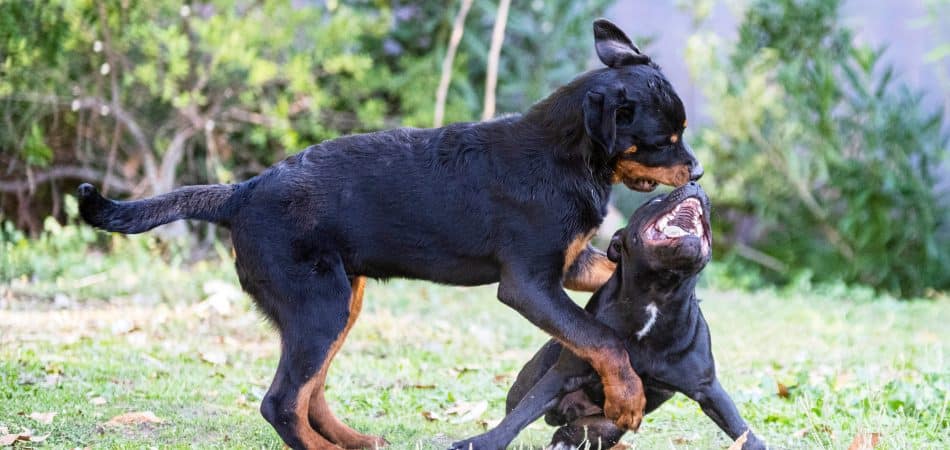
So when something feels off in the pack, they don’t shrug it off; they respond. And sometimes that response shows up as tension, posturing, or even a full-blown fight.
If you want absolute control of the pack, you’ve got to pay attention to the undercurrent. And that starts by understanding what actually causes pack conflict in the first place.
So, let’s start there…
In my experience, most conflicts between protection dogs trace back to one or more of the following factors:
Understanding what causes conflict is only half the work. The fundamental shift comes when you know how to lead through them. So, let’s go deeper.
Pain changes everything. It rewires tolerance, distorts perception, and makes even the gentlest dog reactive, edgy, withdrawn, or explosive. And because protection dogs are trained to push through discomfort, they rarely show pain in the way we expect. They don’t whimper. They don’t limp unless it’s bad. They just get… different.
Sometimes that difference is subtle—a hesitation on a jump, a slight shift in gait, a new edge to their interactions with other dogs. And sometimes it looks like an unprovoked conflict, but it’s not.
Pain shrinks a dog’s bandwidth. That one sniff from a packmate they’d usually ignore? Now it feels like pressure. That accidental shoulder bump? Suddenly, it’s a threat.
So, before you look for training issues or pack structure flaws, start with the body.
Check the joints, teeth, ears, and gut. Look for what doesn’t belong—heat, flinching, stiffness, and avoidance.
Even better, bring in a vet or a canine chiropractor who understands working dogs.
Dogs don’t just compete for survival. They compete for access, space, water, food, position, and attention. Not always out of desperation, but often out of instinct.
In a multi-dog household, conflict over resources doesn’t always start with a snarl. It can start with a stare. A slow body block at the water bowl. One dog eating faster than usual because another is hovering too close. These moments don’t scream danger, but they whisper hierarchy.
The dog who’s always the last to eat might start guarding scraps. The dog who used to wait patiently might start lunging.
The tricky part?
You might not see it coming because you know there’s plenty to go around. But to them, resources are only as abundant as they feel. And if things feel scarce, peace starts to crack.
So what do you do?
Even access to your attention and praise can become a trigger if one dog starts claiming you. That means you must be intentionally fair.
We often say dogs are pack animals, which is true. But even pack animals need room to breathe.
Protection dogs value proximity only when it feels safe, earned, or necessary.
If you cram them together with no exit strategy, defined zones, or personal boundaries, you’ll start to see stress show up as conflict. A side-eye turns into a lip curl. A shared crate turns into a standoff. And suddenly, two stable dogs are toe-to-toe over nothing more than proximity.
But it’s not about space in square footage. It’s about space as respect.
So give them options. One crate per dog. One resting spot that’s theirs alone. Avoid stacking them emotionally—no crowding during feeding, loading, training, or transport.
And if you notice tension rising, don’t force resolution. Create distance and let things cool.
And most of all, avoid forcing intimacy.
Just because two dogs coexist doesn’t mean they’re ready to lie side by side, especially when a new pack member enters the picture.
They’re still reading each other and still learning boundaries. Let them have the room to figure it out before you push them closer.
Some dog fights happen because of boredom.
Boredom in a high-drive protection dog isn’t passive; it’s electric and hums under the surface. It turns into pacing, fixation, over-sensitivity, or control-seeking behaviors. And when there’s no outlet for that energy, it turns inward… or sideways.
Some dogs will pick fights just to feel something. That’s how strong the need for purpose is.
These dogs were bred to work, not just to be. And when you take the job away, you invite chaos in its place.
So give them structure:
Some dogs bring baggage, especially if they were mishandled, overcorrected, or stressed during early training. These emotional scars can show up as fear-based aggression, territoriality, or hypervigilance around other dogs.
What to do:
Not all dogs are meant to coexist.
Even when the training is solid or the intentions are good. Some combinations—especially between dominant males or dogs from conflicting bloodlines—carry tension from the moment they meet.
Why? Because genetics shapes drive levels, confidence, nerve strength, recovery speed, and social tolerance. One dog may crave structure and control, while another thrives on fluidity and softness.
And when those temperaments clash, no amount of training will override biology.
So be picky.
Every pack has a hierarchy, even if subtle. Adding a dog, losing one, or even having a maturing puppy can shift the dynamic. Something as natural as a female coming into season can stir the waters.
During these transitions, dogs reevaluate their roles. Sometimes they adapt quietly. Other times, they test the boundaries and each other.
Watch closely when transitions happen.
We can all agree that a female’s estrous cycle changes the atmosphere. You may not see it right away, but the dogs do. Especially intact males. They pick up on the shift before any visible signs appear. And even those who aren’t directly involved feel it.
The scent, tension, and the low hum of possessiveness move through the pack like static.
These moments don’t mean your training failed. They show that biology is louder than your rules.
So manage it.
Spaying or neutering may help in some environments, but it’s not a blanket fix. Hormonal management is an ongoing responsibility for multi-dog owners.
Too little supervision, and things spiral. Too much, and you end up doing all the work for them—blocking communication, bottling tension, and unknowingly building pressure where resolution could’ve happened.
Dogs need to learn to read each other and resolve low-level disagreements themselves.
If you step in every time they growl or posture, you may be freezing normal communication and setting the stage for bigger blow-ups.
What to do:
You’re the leader, not the referee of every squabble. Pick your moments.
If fights become frequent, injuries occur, or certain dogs remain aggressive despite intervention, it’s time to bring in a professional.
Now, most people wait too long. They think more time will fix it. But time doesn’t fix behavioral issues. Action does.
Every day you wait, the problem gets more expensive. Not just in money but in trust, safety, and the risk of someone getting hurt.
So if you’re reading this thinking, “Maybe I should get help,” you already know the answer.
You can invest in the right training today or pay for the consequences tomorrow.
And if you decide to go with the first option…
…Contact Vanguard Protection Dogs. We specialize in high-drive protection dogs and training solutions that work.
 904-441-8475