Watch a protection dog’s body language by taking in the whole animal so you can tell if it’s calm, attentive, or getting defensive or aggressive. Pay attention to five simple signs: tail, ears, eyes, mouth, and general stance.
Noticing these small changes helps you avoid problems and builds a stronger relationship with your dog.
We trainers, put a lot of weight on body language. Not just ours, but our dog’s too. See, when working with protection dogs, it’s never just about commands, obedience, scent work, or bite work. Training goes deeper than that.
We’re teaching the dog to read you—the handler. Your nonverbal signals, posture, tone, breathing, and the way you shift your weight… they notice things you don’t even realize you’re doing.
It’s almost unfair how sharp they are at picking up on your cues. And the real challenge is flipped on its head: can you read your dog’s body language just as well?
Because your protection dog is talking to you constantly without even making a sound. The tilt of their ears, the set of their tail, the tension (or looseness) in their body… Every detail is a signal.
Put together, those signals can mean anything from “I’m calm” to “Something’s not right; stay sharp.”
And that’s where many owners stumble. They either miss the message or, worse, misinterpret it. In protection work, that small gap in understanding can turn a challenging moment into a dangerous one.
So, in this guide, I’ll break down the meaning behind the most common body language signals your dog uses and how you can interpret them the right way.
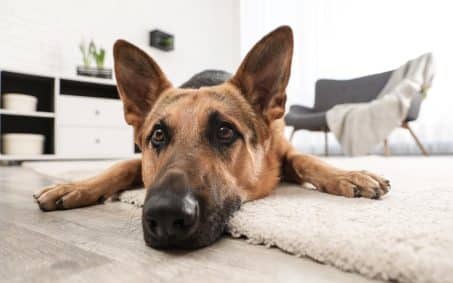
 A relaxed dog is the baseline you want most of the time. It means they’re comfortable in the environment, open to interaction, and balanced enough to switch off when the world is safe.
Their whole body gives off a loose, easy vibe, almost like they’re saying, “I’m good. Life’s good.”
You’ll notice it first in the small details. Their ears sit naturally, never stiff or strained. Pointed ears stand tall but soft, while floppy ears hang with a gentle forward tilt. Their eyes match that same mood, soft and open, with no wrinkles or tension pulling at the forehead.
The mouth adds another clue. A relaxed dog may keep it closed without tightness in the lips or, if they’re moving around, let it fall open in easy pants. There’s no strain or clenched jaw, just a loose, natural expression.
Then there’s the tail, one of the most obvious signals. A relaxed tail wags in a wide, sweeping arc at the level of the spine, steady and easy. During play, you might see it carried a little higher, but it still holds that loose, friendly rhythm.
The posture ties it all together. A relaxed dog looks soft in the body—sometimes even wiggly. Movements might be bouncy or exaggerated during play, but never rigid or tense. That kind of body language says your dog is comfortable enough to just be themselves.
But “relaxed” isn’t the only state you’ll see. When something shifts in the environment, that softness disappears, and your dog moves into alert mode.
In that moment, focus takes over. They’ve locked onto something in the environment, and now every muscle in their body is tuned like a spring.
In protection work, this is your cue to scan the environment, as the dog often detects threats first.
This is the point where the dog is no longer just alerting you to a potential problem; they’re preparing to deal with it head-on.
A handler must read this state with precision. Aggression isn’t “anger” in the human sense—it’s a calculated response to perceived danger. Well-trained dogs can dial aggression up or down on command. But that only works if you’re fluent in spotting the signals before and during the escalation.
Handle it poorly, and control unravels fast, turning the situation into a dangerous moment.
Unlike alertness, which is focused and sharp, anxiety is restless and uncertain. Your dog feels something, but doesn’t know what to do with it.
The ears may flick back and forth, unable to settle in one position. Their eyes dart or widen, sometimes showing more of the white (what trainers call “whale eye”). Wrinkles can appear across the forehead as tension creeps in.
The mouth tells another story. Tight lips, corners drawn down, or panting that feels shallow and quick rather than relaxed.
Some anxious dogs lick their lips or yawn excessively, small displacement behaviors that signal internal conflict.
The body won’t settle either. Tails tuck closer or wag in short, uncertain flicks. Movements turn jerky or hesitant. Some dogs pace or shift weight repeatedly, unable to fully settle.
Anxiety clouds judgment and makes clear communication harder.
As a handler, your job is to catch it early, guide them through it, and help them reset before it bleeds into performance.
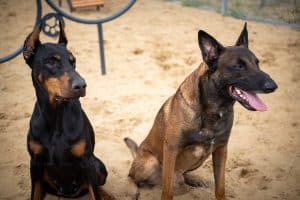 Not every signal your dog gives is about threat or readiness. Sometimes, they’re communicating respect, de-escalation, or even an attempt to smooth over tension. These are appeasement or submission signals, and they’re just as crucial for a handler to recognize.
You’ll often see the ears fold back softly against the head, paired with squinting or lowered eyes that avoid direct stares.
The mouth may stretch into what looks almost like a grin—corners pulled back with lips relaxed. Sometimes, there’s a little tongue flick or quick licking at the air or your hand, a polite gesture that says, “I’m no threat.”
The tail usually drops lower than the spine, wagging in small, quick motions that are less about joy and more about appeasement. The body posture becomes low and curved, even rolling partly onto the back with the belly exposed.
These signals mean your dog understands social cues and knows how to avoid unnecessary conflict.
Fear is different from anxiety—it’s deeper, sharper, and often more dangerous. A fearful dog, especially one that feels cornered, can lash out unpredictably.
The ears tell the story first, pinned tightly back against the skull. The eyes widen, whites flashing, or dart away to avoid contact. The forehead creases, but this time with avoidance, not focus.
The mouth often pulls tight, with lips drawn back, or shows stress panting (rapid, shallow, and paired with drooling). Some fearful dogs go silent, while others whine, yelp, or bark sharply.
The body shrinks. The tail tucks hard under the belly, posture low, weight shifted back, hackles rising not from confidence but from self-defense.
For handlers, fear is a red flag. A cornered, fearful protection dog is dangerous because clarity is gone. Your role is to create space, defuse pressure, and restore trust before fear drives the negative reaction.
Even experienced owners misread signals sometimes.
Here are the biggest pitfalls:
A dog bouncing around with loose, exaggerated movements is probably just thrilled to play. But tighten those movements, stiffen the body, add a sharp bark—and you’ve crossed into agitation.
The two can look similar on the surface, but the energy behind them is entirely different.
This one trips up a lot of people. A wagging tail isn’t a universal “happy” signal. The speed, height, and stiffness of the wag tell the real story.
Wide and low is relaxed. High, stiff, and fast means tension. Context is everything.
Most owners only notice the obvious: growls, barks, or hackles. But long before those, your dog is sending quiet messages: a lip twitch, a slight freeze, and weight shifting forward.
Miss those, and by the time you realize what’s happening, your dog is already escalating.
This might be the biggest pitfall of all. Dogs don’t feel “guilt” for knocking over the trash or chewing your shoe.
When you read human emotions into canine signals, you miss what your dog is actually communicating.
This is where you build the bond between you and your canine companion. This is where you win control.
How do you go about it?
Don’t wait for a training session to study your dog. Pay attention during walks, at home, or when visitors come by. Every day moments help you notice the little shifts in body language.
Every dog has a “normal”: how they carry their ears, where their tail naturally sits, and the rhythm of their breathing.
When you know your dog’s baseline, it’s easier to catch the subtle deviations that signal stress, alertness, or fear.
Start with one feature at a time. Spend a week really noticing tails, then move to ears, then posture. Over time, you’ll start connecting the dots faster, until the whole picture comes together instinctively.
And if you want to sharpen that skill fast? Don’t do it alone. Work with a trainer who’s lived in the trenches of protection work. Someone who can point out the signals you’re blind to and teach you to respond with calm, decisive confidence instead of hesitation.
That’s precisely what we do at Vanguard Protection Dogs. We don’t just train protection dogs and hand them off—we train handlers too. Because what good is a world-class protection dog if the person holding the leash can’t read what that dog is saying?
The truth is simple: the better you understand your dog, the safer, sharper, and more effective your partnership becomes.
And when both sides of the leash are trained to the same standard, that’s when you unlock the full potential of your protection dog.
Don’t wait for a close call to realize you’re not ready. Start training with Vanguard Protection Dogs today—because protection starts with understanding. Book a free consultation now.
 904-441-8475