One word: Come. The recall command.
It sounds deceptively simple, and yet in practice, it might be the most difficult—and most critical—cue your dog ever learns.
Every time you say “come,” you’re asking your dog to override instinct. To abandon the chase, ignore the scent trail, skip the squirrel, stop mid-charge, or turn away from something they find thrilling or even threatening. You’re asking them to choose discipline over desire, obedience over adrenaline.
That’s no small ask.
In the real world, “come” is a high-stakes command. There’s very little margin for error. That single word might be the only thing standing between safety and disaster.
So, will your dog stop on cue when they’re trotting, sprinting, or fully locked in on something else?
For any dog with off-leash freedom, recall is non-negotiable. Personally, I can’t imagine owning a dog I couldn’t stop in an instant.
And honestly? If your dog doesn’t have a reliable recall, you should be a nervous wreck every time you step onto a trail—especially if they’re the kind to flush a rabbit from the brush.
But you don’t have to live that way. In fact, if you’re not confident your dog will respond the first time you call, they shouldn’t be off-leash at all.
That’s why the recall command is something every serious trainer and handler works relentlessly to perfect—and never stops refining.
Now, how do you build a bulletproof recall in a protection dog? We’ll break it down for you.
But before we jump into the how, let’s get clear on why recall fails in the first place…
Protection dogs aren’t disobedient by nature. Far from it. They’re sharp, driven, and eager to work. But those same traits make the recall a challenge.
You’re working with a dog bred and trained to act, pursue, confront, and respond to threats.
Their instincts are dialed in, their arousal levels spike fast, and when they’re in motion, they’re in it. Stopping mid-run doesn’t come naturally. It takes serious work.
Now add in distractions—kids on bikes, wildlife darting past, unfamiliar noises, even the presence of a potential threat—and you’ve got a high-stress situation where you’re asking your dog to override everything in their system… and listen to you instead.
Recall in that moment tests your relationship, consistency, and your dog’s trust in your leadership.
Let’s walk you through the process:
You don’t start teaching recall at the dog park or in the middle of an open field. You start small, quiet, and controlled.
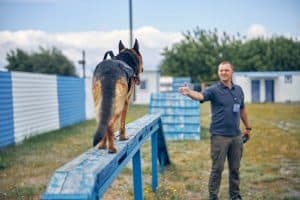
Leash work. Long line work. Repetitions.
You say “come,” and the moment they turn towards, you reward. Not just a “good boy,” but something they really care about. Food. Tug. Ball. Whatever lights them up.
You’re making one thing clear: coming back to you is the best decision they can make.
Once they’re consistent on the long line, you up the ante. Distance increases. So do the distractions.
You toss a ball, let them start after it, then give the cue. If they don’t hesitate and turn back to you, throw a party. If they blow you off, stay calm, reset, and try again. No yelling or frustration. Just clarity and reps.
This is where most handlers stall out. They ask too soon, with too much going on, and punish failure instead of reinforcing progress.
As we mentioned earlier, recall is built on trust. If your dog starts to think that “come” means “fun ends,” or “you’re in trouble,” they’ll hesitate—or worse, ignore you entirely.
This is the final phase. You take your recall out into the world—safely, slowly, and with backup plans.
You can practice near streets (on leash), around distractions, during play, and at the park. Mid-run. Mid-guard scenario. Mid-drive.
See, the goal is simple: no matter what your dog is doing—chasing, playing, or during an adrenaline rush—they should hear that one word and drop everything.
Nothing else matters. Just you.
That’s the only command that keeps them and others safe. It’s the command that could change everything.
Protection dogs operate in high-pressure scenarios. Their recall shouldn’t just be “pretty good”—it should be rock-solid under real-world stress.
Here are a few advanced drills serious handlers use to bulletproof the command:
Let your dog engage in something high-intensity—chasing a ball, running toward a bite sleeve, tracking scent—and then call them off mid-action.
Hide. Literally.
Step out of view. Let your dog get focused on something else—then drop the “come” command from behind a tree, around a corner, or behind a vehicle. No visual cues or gestures. Just your voice cutting through the distance.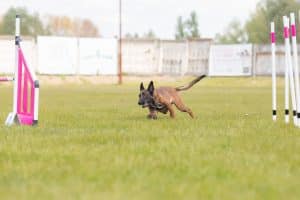
You’re testing response and urgency at this point. Will your dog abandon the distraction and sprint toward you based on your voice alone? That’s what you’re looking for.
This drill can be one of the most powerful tools in your recall training. In the real world, you won’t always be in sight. You could be injured, you could be pinned, or your dog could wander out of range—toward a road, a threat, or just too far from safety.
In those moments, you don’t have time to chase. You don’t get a second chance. Your voice is the only lifeline you’ve got.
Out-of-sight recall bridges that gap. This is not about tricks, it’s about trust—pure and simple.
Some handlers use a second, ultra-high-value recall cue—something reserved for emergencies only. It could be a distinct whistle or a specific word only used in life-or-death moments.
You condition it with massive rewards, but only use it in training rarely. When it matters most, that cue should cut through chaos like a lightning bolt.
Every trainer hits a wall at some point. It’s part of the process.
What matters is how you respond when progress stalls.
Stay realistic about your dog’s training level and their breed tendencies. Some dogs are naturally more independent. Others are more prey-driven. Some are just plain stubborn.
That doesn’t make recall impossible. It simply means you’ll need to adjust your approach, remain patient, and tailor your expectations to match the dog in front of you.
Here are a few common issues that crop up during recall training, and how to handle them without losing your mind—or your dog’s trust.
Fix: This is usually a motivation issue, or they’ve been burned before. If “come” has ever meant “fun’s over” or “you’re in trouble,” your dog may second-guess it. Go back to basics. Reinforce it the moment they make the right choice. Make coming to you feel like hitting the jackpot.
Fix: You’ve got a consistency problem. Maybe you’re repeating the command. Maybe you’re letting them blow you off without consequence. Either way, go back to controlled environments where you can enforce the cue. Make it clear: “come” always means now, not maybe later.
Fix: You jumped the gun. It’s not that your dog won’t listen—it’s that they can’t focus at that level yet. Scale back. Work just outside the distraction threshold. Build distance, duration, and focus slowly. Reinforce heavily for success, and keep distractions predictable until they’re solid.
Fix: That’s called a negotiation, not obedience. And it’s usually a sign you’ve been inconsistent with timing or follow-through. Reinforce immediate responses only. Don’t reward “eventual compliance.” It’s either right or it’s a redo.
Fix: Smart dogs figure out patterns fast. If every recall means the game ends or the leash goes on, they’ll resist. Mix things up. Sometimes call them just to release them again. Sometimes call them into something better. Keep recall a source of good news, not a buzzkill.
A protection dog with a weak recall isn’t ready to work. It doesn’t matter how sharp their bite is, how intimidating their bark, or how perfectly they hold down. If they won’t stop and return when called, you’ve got a liability, not an asset.
But when you dial in recall, you’ve got total control. You’ve got a dog who listens through adrenaline, distractions, and danger. You’ve got a partner you can trust—no matter what’s happening around you.
So if you’re going to master one command, make it this one.
And if you can’t quite nail it on your own, Vanguard Protection Dogs can help. We build dogs with real-world readiness.
Contact us today—and let’s build that trust.
 904-441-8475