Families with young children who are considering a trained protection dog share one central concern: whether a dog capable of physical intervention can be trusted around toddlers, school-age children, and unpredictable household activity. The short answer is yes, with the right breed, the right training level, and the right placement process.
A properly trained personal protection dog is conditioned to distinguish between genuine threats and household activity, showing patience and affection with family members while maintaining territorial alertness in genuine threat scenarios. Standardized temperament testing, structured introduction protocols, and age-appropriate household rules are the three pillars that determine whether a protection dog and a family with young children become a safe, functioning household unit.
Jacksonville families with young children who are evaluating a protection dog placement face a question that most security advisors cannot answer: how does a dog trained to physically respond to threats behave around a three-year-old running through the house, a teenager’s friends visiting after school, or a toddler who has not yet learned to read a dog’s body language signals?
The answer depends on three variables that serious placement programs treat as non-negotiable: the temperament standard the dog was evaluated against before placement, the breed selected for the specific household profile, and the introduction and onboarding process used to establish the dog’s role within the family. A protection dog that passes all three is not a liability around children. It is a daily companion that also functions as a security asset.
What follows is a framework for Jacksonville families with children of any age to evaluate a protection dog placement accurately, starting with the temperament standard and working through breed selection, introduction protocols, and long-term household management.
Before a trained protection dog is placed in any family home, it should pass a standardized temperament test (TT) evaluating its behavior around unfamiliar adults, children, loud or unpredictable activity, and other animals. A dog that cannot demonstrate stable, non-reactive behavior in neutral environments does not meet the baseline standard for a family placement, regardless of its protection training level.
The American Temperament Test Society (ATTS) administers standardized temperament tests that evaluate a dog’s response to environmental stimuli including sudden sounds, unexpected movement, physical approach by strangers, and threatening scenarios.
A dog that passes the TT demonstrates the ability to distinguish between neutral and threatening situations, responding calmly to the former and appropriately to the latter. For families with children, this distinction is the most important behavioral characteristic a protection dog can possess. A dog that reacts aggressively to a child knocking over a glass has the wrong temperament for a family placement, regardless of how well it performs in protection sport.
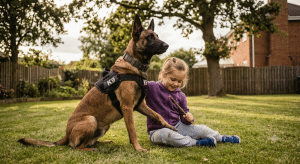 A properly trained protection dog should never show unprovoked aggression toward family members, household guests, or strangers in neutral settings. Protection instincts are designed to activate in response to genuine threat indicators, not normal household activity.
Dogs that show reactivity to children’s movement, loud voices, or play behavior have either a temperament issue, a training gap, or both.
Reputable placement programs screen for these behaviors before any family placement and will not place a dog that cannot pass an independent temperament evaluation.
The period immediately following placement, typically 3 to 30 days depending on the dog and household, is when the protection dog establishes its understanding of the household hierarchy, its relationship with each family member, and its role within the home environment.
During this window, structured introductions, consistent commands, and predictable daily routines help the dog map the household social structure correctly. Children should be introduced gradually, starting with calm, controlled contact and building toward normal household interaction as the dog demonstrates comfort and stability with each family member.
Safe introduction of a trained protection dog to young children follows a structured sequence that prioritizes calm, controlled contact before progressing to normal household activity. The sequence typically spans 1 to 3 weeks depending on the dog’s adjustment pace and the ages of the children involved. Rushing the introduction process is the most common mistake families make in the first days after placement.
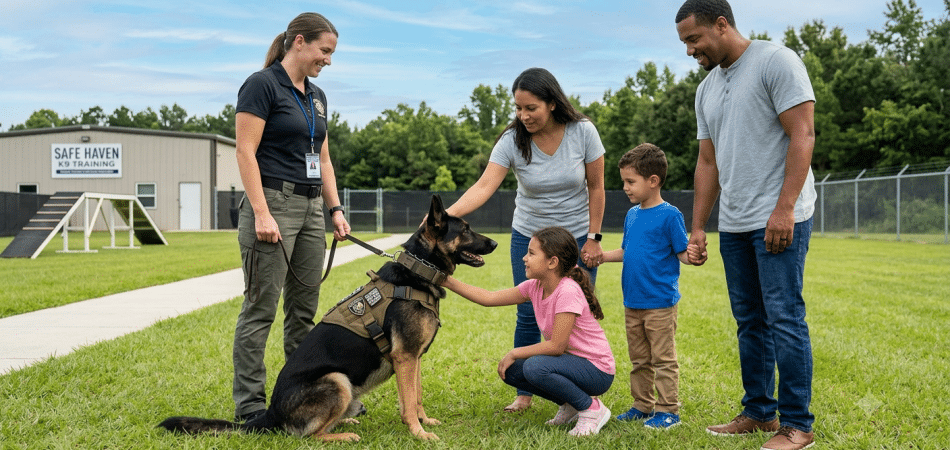
Professional trainers recommend a four-stage introduction process for households with children under 10. Stage one is a controlled first meeting with the dog on leash and children seated and calm. Stage two involves leashed interaction with children standing and moving at a normal pace.
Stage three introduces brief off-leash contact in a contained space with an adult handler present. Stage four is supervised off-leash household integration across all normal daily activities. Each stage should be repeated until the dog demonstrates consistent calm before advancing. Vanguard’s distinctive approach to placement includes a 3-day immersive onboarding experience that walks new owners through this exact process, including specific protocols for households with young children.
Infants and toddlers under 3 require the slowest introduction timelines because they cannot reliably modify their behavior based on the dog’s body language signals. Dogs placed in households with very young children need additional time to acclimate to unpredictable movement, sudden noise, and irregular contact before unsupervised access is appropriate.
Children ages 6 to 12 generally adapt to introduction protocols more quickly because they can follow instructions and learn to read dog body language with adult guidance. Teenagers are typically the easiest household members to introduce to a newly placed protection dog, as they can participate in command reinforcement and structured interaction from day one.
The most common introduction mistakes in families with young children are allowing unsupervised contact too early, permitting children to engage in rough play before the bonding period is complete, and failing to enforce consistent commands across all household members.
A protection dog that is corrected by one family member and permitted to ignore another will not have a stable household hierarchy, which creates behavioral unpredictability. Every adult in the household should use the same command vocabulary and the same behavioral expectations from the first day of placement.
Long-term safety in a household with both a trained protection dog and young children depends on consistent household rules applied by every adult, clear age-appropriate interaction boundaries for children, and ongoing reinforcement of the dog’s household role. Families that maintain structure beyond the initial bonding window have significantly fewer behavioral issues than those who relax rules once the dog appears settled.
Regardless of the ages of children in the household, three rules apply universally in every professional protection dog placement. First, no child should ever approach the dog during feeding or when the dog is in its designated rest space. Second, rough play, including wrestling or chasing, should not be permitted until the dog’s full household integration is confirmed and the behavior is cleared by the placing trainer.
Third, all correction and command reinforcement should use the same vocabulary and tone as established during onboarding. Families who want to understand how these rules fit into the broader placement philosophy can read more at Vanguard Protection Dogs, where the 5-Pillar System details each stage of the ownership relationship from initial matching through lifetime aftercare.
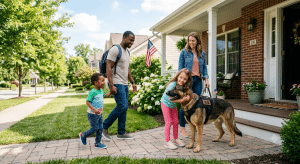 Children under 5 should always have adult supervision during any contact with the protection dog until the dog has been in the household for a minimum of 30 days and has demonstrated consistent calm behavior around the child across a variety of daily scenarios.
Children ages 5 to 10 can begin participating in structured command reinforcement with adult oversight, which serves both to reinforce the dog’s training and to build a positive handler relationship between the child and the dog. Children 11 and older can learn the full command vocabulary and, with trainer guidance, begin taking on daily interaction responsibilities that strengthen the dog-child bond over time.
Minor behavioral conflicts between a newly placed protection dog and household children are normal during the adjustment period and do not indicate a failed placement. A dog that growls when a toddler pulls its tail is communicating, not malfunctioning. The correct response is to separate the animals, redirect the child, and contact the placing trainer for guidance before the next interaction. A dog that escalates beyond a warning growl to a snap or bite during normal household activity is a different situation that requires immediate trainer consultation. Reputable programs provide guaranteed response within 24 hours for exactly these scenarios.
Breed selection is the first and most consequential variable for families with young children considering a protection dog. Not all protection breeds offer the same combination of household temperament and family compatibility. German Shepherds and Dutch Shepherds are generally considered the most family-adaptive working breeds, while Belgian Malinois require more active management in households with very young children due to their higher daily energy requirements.
German Shepherds have the longest track record as family-integrated working dogs and are widely regarded as one of the most child-friendly large working breeds available. The breed’s natural affinity for household routine, its patience during play, and its strong bonding instinct with all family members make it the most commonly placed protection breed in homes with young children.
Dutch Shepherds offer a similar temperament profile with slightly higher daily energy requirements and a longer lifespan averaging 11 to 14 years, making them a strong alternative for active families with outdoor lifestyles.
Belgian Malinois are among the most capable personal protection breeds in the world, but their exceptionally high daily exercise requirements and intensity of drive make them a more demanding fit for households with toddlers and infants.
The breed performs best in family settings where children are old enough to participate in structured interaction and where adults can consistently provide 2 or more hours of vigorous daily exercise. Families with children under 5 are often guided toward German Shepherds or Dutch Shepherds as more immediately compatible household protection breeds.
Matching the right protection breed to a specific household is not a one-size-fits-all decision. Property size, children’s ages, existing pets, daily activity level, and the primary security concern all factor into which breed will perform best in a given placement. Families navigating this decision can also reference how to introduce a protection dog to your family for additional guidance on the post-placement adjustment process, which is equally important to breed selection in determining long-term household success.
Vanguard Protection Dogs, based in Jacksonville, FL, has matched fully trained protection dogs with family households for more than 16 years. Every placement includes a 3-day immersive onboarding experience that covers household introduction protocols, age-appropriate interaction guidelines, command reinforcement for all household members, and specific guidance for families with young children. Lifetime aftercare support with a guaranteed 24-hour response ensures families are never left managing a behavioral question without expert guidance.
With AKC-registered dogs, FCI certification, OFA health evaluations, and a performance and health guarantee on every placement, Vanguard’s 5-Pillar System covers every stage from initial breed matching through long-term family integration. Only 12 to 15 dogs are placed per year, keeping each placement carefully matched and comprehensively supported.
Jacksonville families with children who are ready to explore a protection dog placement can reach Vanguard Protection Dogs at (904) 822-1609 or schedule a consultation to discuss breed fit, household profile, and current availability.
Vanguard Protection Dogs is based in Jacksonville, Florida, and delivers fully trained protection dogs nationwide with a concierge onboarding experience.
A trained protection dog that passes standardized temperament testing before placement is safe around children in supervised, structured household environments. The dog is conditioned to distinguish between household activity and genuine threats, responding calmly to the former and appropriately to the latter. Supervision during the first 30 days of placement is standard practice regardless of the dog’s training level or the age of the children involved.
German Shepherds and Dutch Shepherds are the most consistently recommended protection breeds for households with young children, combining high-drive protection capability with household temperament stability and strong family bonding instincts. Belgian Malinois are highly capable but better suited to families with children old enough to participate in structured interaction. Rottweilers and Doberman Pinschers are also viable with the right introduction process and consistent household management.
The initial bonding window between a newly placed protection dog and household children typically spans 3 to 30 days depending on the dog’s temperament, the children’s ages, and the consistency of the household introduction process. Structured, gradual introductions produce faster and more stable bonding outcomes than uncontrolled first-contact scenarios. Most families report confident off-leash household integration within 2 to 4 weeks when following a professional onboarding protocol.
Yes. Children under 5 should always have adult supervision during contact with a newly placed protection dog until the dog has demonstrated consistent calm behavior across all daily household scenarios for a minimum of 30 days. This is standard practice recommended by professional trainers for all family placements, regardless of the dog’s training level or the breed involved.
Children old enough to follow adult instruction, typically ages 6 and up, can begin participating in structured command reinforcement with adult oversight. This builds a positive handler relationship between the child and the dog over time. The placing trainer should establish which commands children are permitted to use and how to deliver them correctly before children begin independent command interaction.
A single growl from a newly placed protection dog toward a child is most often a communication signal indicating discomfort, not an aggression incident. The correct response is to separate them calmly, redirect the child, and contact the placing trainer for guidance before the next interaction. Reputable programs provide response within 24 hours for exactly these scenarios. A dog that escalates beyond a growl to a snap or bite during normal household activity requires immediate trainer consultation.
A well-bred and properly trained protection dog with a stable temperament will naturally adjust its physical behavior around smaller, more fragile household members as it learns the household’s social structure. This adjustment is part of the bonding process and becomes more reliable as the dog spends more time in the household. Supervised introduction periods allow the dog to learn appropriate behavior around infants and toddlers before unsupervised access is permitted.
A trained protection dog is specifically conditioned not to show unprovoked aggression toward anyone in neutral settings, including children, guests, and strangers encountered in public. An aggressive dog shows reactivity, resource guarding, fear-based responses, or dominance behavior that is not controllable by the handler. A protection dog’s responses are deliberate, controlled, and handler-directed. The presence of children does not trigger protection responses in a dog with the correct temperament and training foundation.
Vanguard Protection Dogs’s 5-Pillar System covers Nature (pedigree and temperament selection), Training (protection and obedience standards), Matching (pairing the right dog to the specific household), Concierge Onboarding (door-to-door delivery with immersive introduction training), and Aftercare (lifetime support with 24-hour response). For families with young children, the Matching and Onboarding pillars are particularly important, as they determine breed compatibility with the household’s child age profile and provide the structured introduction process that establishes safe household integration.
Fully trained personal protection dogs from elite programs start at $100,000. This investment covers the dog’s pedigree, training to an advanced protection and obedience level, health certifications, concierge delivery, immersive onboarding, and lifetime aftercare support. For families evaluating the cost against the value of comprehensive personal and family security, the one-time investment compares favorably to ongoing alternative security expenses.
 904-441-8475